Greetings AAUP@CSU Members and Supporters,
The semester is off to a busy start! Here’s the latest from AAUP@CSU.
[Take Action] [Stay Informed] [Get Support] [Join AAUP-CSU]
Take Action
Postcard Campaign for Free Speech, Academic Freedom, and Student Centers


In September, we launched a Postcard Campaign for Free Speech, Academic Freedom, and Student Centers.
AAUP@CSU is teaming up with ASCSU to help our community let the administrators of the CSU system know how we feel about attempts to undermine research and curricular independence, close student centers, curtail academic freedom, and constrain freedom of speech on our campus.
It’s important that the leaders of our system hear how faculty, students, and staff have been impacted, and how they, CSU alumni, and fellow Coloradoans would like our administration to respond to future threats.
We designed postcards on which any member of our community can tell their story and voice their concerns. We are currently collecting postcards to be delivered to the Board of Governors when they meet on our campus on October 9th. After that, postcards may be mailed directly to the CSU system office.

We collected hundreds of postcards in two days of tabling on the Lory Student Center Plaza. Students, faculty, staff, and other members of the community voiced their concerns about new CSU restrictions on faculty and student speech, revoked federal grants, and federal pressure to alter our curriculum and close campus cultural centers.
We need your help to expand this effort! If you would like a set of blank postcards to share with colleagues, friends, neighbors, and family members—anyone in the CSU community or the state of Colorado is invited to fill out a postcard—contact Communications and Organizing Co-Chair Karrin Anderson.
Let Chancellor Tony Frank and the Board of Governors know that we want them to strongly oppose partisan attempts to undermine academic freedom.
The postcard campaign will be active through the end of the Fall 2025 semester.
Offer Public Comment at the Board of Governors Meeting

On Thursday, October 9, 2025, The CSU Board of Governors is meeting in the Longs Peak room on the CSU campus. The meeting will begin at 9:00 a.m. with a public comment period in which faculty, students, and staff may sign up to make short (~ 2 minutes) statements to the board.
AAUP@CSU will be there to make a statement and present the board with postcards from our Postcard Campaign for Free Speech, Academic Freedom, and Student Centers . We need you to stand with us!
Arrive between 8:00-9:00 a.m. to sign up. Commenters are allowed to speak on a first-come, first-served basis. Use your 2 minutes to share your views with the board on topics like the university budget, changes to the free speech and peaceful assembly policy, responding to pressure from the federal government and special interests, lost grant support, or other concerns.
Act Now to Save Funding for Science, Research, and the Arts

President Trump’s attacks on funding for the arts and the humanities, as well as support for scientific and medical research, might well reach the level of an existential threat if his 2026 budget is approved by Congress. His draconian cuts to the National Endowment for the Arts and the National Endowment for the Humanities last spring are being followed by proposals to eliminate these programs altogether. The budget put forward by the administration also includes a nearly 40% cut to the National Institutes of Health and an almost 50% reduction in funds for the National Science Foundation.
Eliminating or slashing support for these agencies would mean a return to the white-washed histories of last century, the erasure of art programs, and the exclusion of already disenfranchised groups from the creative and scientific life of this country. The loss of funding would end life-saving research projects, shutter labs, eliminate jobs, and cut graduate programs.
The American Association of University Professors is asking members in all states to call or write to their elected officials and urge them to protect research funding (https://www.aaup.org/about/programs/government-relations/fighting-science-and-research-funding) . While budget negotiations are currently stalled, and a partial federal shut-down looms, the Congressional budget process will eventually resume, and legislators will determine specific levels of funding – if any – for all these agencies.
Suggestions for what to include in your call or letter:
- Maintain funding levels for the National Institutes of Health, the National Science Foundation, the National Endowment for the Humanities, and the National Endowment for the Arts.
- Strengthen the legislative language and oversight efforts to ensure the Trump administration disburses federal grants in accordance with existing law and free from political interference.
- Preserve the appropriations provision that prohibits the Trump administration from making unilateral changes to indirect costs – changing the formula for how grant funds are disbursed would seriously endanger key operations at colleges and universities.
- Protect access to education by opposing cuts to Pell grants for students with financial need, the TRIO program supporting first generation college students, loan programs for graduate students, and income-based repayment plans that protect college graduates against default.
How to contact your legislators:
Colorado Senators
- Michael Bennet (202) 224-5852
- John Hickenlooper (202) 224-5941
Colorado Representatives, Fort Collins area
- Joe Neguse (2nd Congressional District) (202) 225-2161
- Gabe Evans (8th Congressional District) (202) 225-5625
- Lauren Boebert (4th Congressional District) (202) 225-4761
Stay Informed
Revised Free Speech Policy Alarms Faculty and Students
by the AAUP@CSU Executive Committee

The revised free speech policy announced by the CSU administration at the September 2, 2025 Faculty Council meeting threatens the right to free speech and peaceful assembly on campus. It was fast-tracked rather than brought to the floor of the Faculty Council to avoid public deliberation, an action that violates the norms of shared governance. Concerns about the new policy (read the new policy and tracked changes here: ) include the following (please click the arrows below to expand each section):
- The new policy is overly broad and often confusing.
2. The new policy adds unreasonable limitations on employee speech.
a. The policy mandates that “speech made in an employee’s official capacity may be subject to institutional oversight,” but does not specify which types of speech constitute “speaking in an official capacity” or what the institutional oversight would entail.
b. The policy contains a “Public Commentary” section that defines public commentary as employees’ “expressive activities as private citizens on matters of public interest.” This definition is broad enough to potentially encompass public scholarship, extension, or engagement work. This is a clear abrogation of academic freedom.
c. The policy states that “Employees may engage in Expressive Activities as private citizens on matters of public interest, so long as those activities do not pertain to or interrupt their official job duties and responsibilities.” This implies that the university has oversight of the free speech rights of private citizens, including any speech relating to education or education policy.
d. The policy appears to restrict faculty members’ use of their academic rank as a professional title.
3. The new policy infringes on students’ rights to free speech and peaceful demonstrations.
a. The new policy limits chalking on the plaza to publicity for programming by CSU units and student organizations, violating people’s right to free speech.
b. The policy puts limitations on the projection of messages on public buildings and surfaces. Symbolic protests that “block the audience’s view” or prevent participation in a university event are forbidden.
c. Camping and encampments” are broadly defined and tightly regulated in ways that violate the spirit of peaceful assembly.
4. The new policy radically redefines “peaceful” to exclude any “act or activity” that violates “applicable law or policy.”
a. This is an overly broad statement that, for example, would categorize non-promotional messages chalked on the LSC plaza as activity that is not peaceful.
Section E.8.2.f of the Faculty and Administrative Professional Manual states that “The major purpose of the University Administration is to provide an atmosphere conducive to teaching, research, extension, and service. Administrators, therefore, must protect, defend, and promote academic freedom as a necessary prelude to the free search for and exposition of truth and understanding.” AAUP@CSU believes that both the approval process for and the substance of the new policy violates one of the most fundamental administrative responsibilities articulated in the Manual.
The Foundation for Individual Rights and Expression (FIRE) has substantial concerns about CSU’s new “Free Speech and Peaceful Assembly” policy.

In response to recent changes to CSU’s “Free Speech and Peaceful Assembly” policy (see “Revised Free Speech Policy Alarms Faculty and Students”), the Foundation for Individual Rights and Expression (FIRE*) shares AAUP-CSU’s concerns that this fast-tracked policy revision
“…constitutes an impermissible restraint on faculty members’ speech and threatens to chill expression. As a public university system legally bound to protect community members’ First Amendment rights, CSU must revise this policy and allow faculty members to speak their minds freely.”
Read FIRE’s full letter to the CSU administration here and then please join the AAUP-CSU in our ongoing Postcard Campaign to ask the CSU Administration and the Board of Governors to Support Free Speech, Academic Freedom, and Student Centers.
The fundamental rights to Free Speech and Peaceful Assembly must be protected for all students, faculty, and staff.
* FIRE (https://www.thefire.org/) is a nonpartisan, nonprofit group whose mission is to defend free speech.
Opinion – Colorado’s colleges and universities need collective action to fight Trump administration policies
Co-presidents of the Colorado Conference of the AAUP, Aaron Schneider (Leo Block chair and professor of International Studies at Denver University) and Steve Mumme (Emeritus professor in the Colorado State University Department of Political Science) make a passionate case for all Colorado Universities to band together to form a mutual protection compact to protect Academic Freedom. “Colorado’s AAUP faculty believe it is time to pursue the path of institutional cooperation and mutual defense. The barrage mounted against our universities has just begun and more threats from government and private actors are sure to come.”
We need to unite today to defend our freedoms for tomorrow. Please join the AAUP mailing list and write you CSU Administration and the Board of Governors to voice your support for the AAUP Mutual Defense Compact for Colorado Institutes of Higher Education.
AAUP@CSU at No Kings October 18

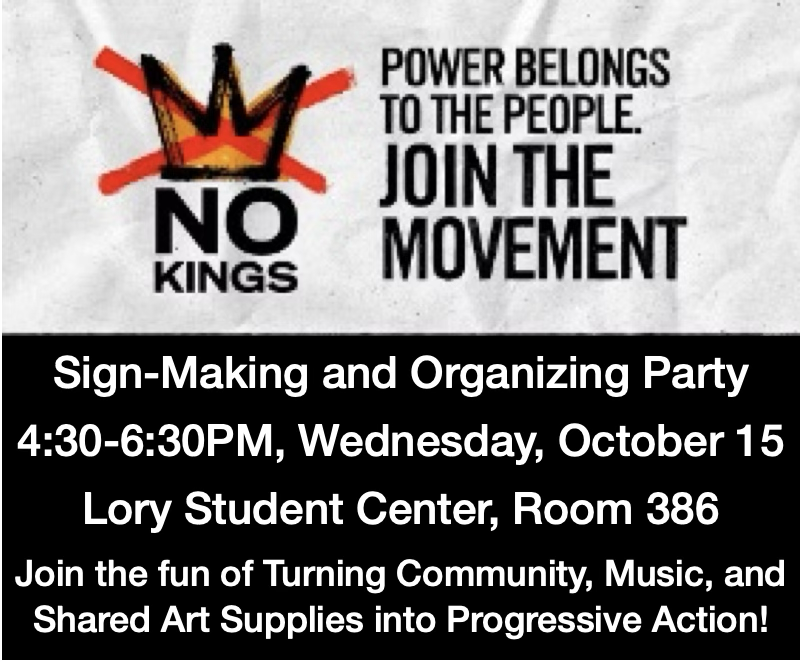
Join AAUP@CSU at the No Kings rally on Saturday, October 18, 9:00-11:30 a.m. in Civic Center Park, 201 Laporte Avenue in Fort Collins.
AAUP-CSU will also sponsor a Sign-Making party on Oct. 16, 4:30-6:30pm in LSC Room 386. Join us for music and shared sign-making supplies, and come prepare a sign to support science, research and the arts.
We want our northern Colorado neighbors to hear more about what’s happening on our campus. Help us distribute postcards for our Postcard Campaign for Free Speech, Academic Freedom, and Student Centers, and recruit new members and supporters for AAUP@CSU.
Look for the tent with the red and white AAUP banner. We will have information about how you can get involved in the struggle to support university employees, retain academic freedom, protect free speech, and keep student support services in resistance against a run-away executive branch that appears to bent against higher education. Come join us to enjoy a day of solidarity and resistance!
_
Get Support
This month’s virtual presentations for AAUP national members includes sessions on Professional Liability Insurance and Legal Resources and an AAUP Primer on Academic Freedom. Check out the full list of national AAUP Events.
Is your department developing policy related to AI in the classroom? Consult the AAUP’s recently published Report on Artificial Intelligence and Academic Professions to learn more about faculty members’ concerns and recommendations related to AI use.
Read the Academe Blog and subscribe to Academe magazine for articles on higher education.
Join AAUP-CSU
Membership Drive

The AAUP@CSU is mobilizing to respond to threats aimed at higher education and changes faculty are experiencing on campus.
We want to grow our numbers and we need your help! Invite your colleagues and friends to connect with AAUP@CSU:
- Sign up for our newsletter.
- Become a member or supporter.
- Attend our monthly meeting the first Monday of each month, 4:00-5:00 p.m., at Ramskeller in the Lory Student Center.